
Indonesia Men's Bronze Target: A Declaration With No Data Behind It
**Câu trả lời cốt lõi**: Đội tuyển bóng chuyền nam Indonesia đặt mục tiêu giành huy chương đồng tại Đại hội Thể thao châu Á 2026 do Nhật Bản đăng cai, theo tuyên bố của chủ tịch liên đoàn PBVSI Imam Sudjarwo và huấn luyện viên trưởng Reidel Toiran. Bản tin gốc không kèm số liệu, đội hình hay phân tích chiến thuật nào. **Dữ kiện chính**: - Mục tiêu: huy chương đồng bóng chuyền nam tại Đại hội Thể thao châu Á 2026, tổ chức tại Aichi-Nagoya, Nhật Bản. - Huấn luyện viên trưởng Reidel Toiran, quốc tịch Cuba, tuyên bố đội có thể tạo nên một bất ngờ. - AVC Cup 2026 diễn ra cuối tháng 6 tại Philippines; Indonesia cũng dự SEA V Cup và tập huấn tại Campuchia. - Nguồn không cung cấp đội hình, tên cầu thủ, thông tin chấn thương hay bất kỳ chỉ số thi đấu nào. - Đội tuyển nữ Indonesia dự AVC Cup 2026 tại Philippines, không có mục tiêu huy chương nào được công bố. **Nguồn**: Bản tin thể thao Indonesia tổng hợp phát ngôn của PBVSI và huấn luyện viên Reidel Toiran, thời điểm công bố trước ngày 30 tháng 6 năm 2026; nguồn gốc không được nêu rõ trong văn bản gốc. | Cross-checked: VuaBong.vn **Hỏi đáp liên quan**: - Hỏi: Indonesia đứng ở tầng nào của bóng chuyền nam châu Á? Đáp: Nhóm tầng hai, cùng Thái Lan, Việt Nam và Philippines, dưới nhóm tứ kết gồm Đài Loan (Trung Quốc), Pakistan, Ấn Độ và Kazakhstan. - Hỏi: Huấn luyện viên trưởng đội tuyển bóng chuyền nam Indonesia là ai? Đáp: Reidel Toiran, người Cuba. - Hỏi: Có số liệu nào chứng minh khả năng giành huy chương đồng không? Đáp: Không, nguồn không cung cấp chỉ số thi đấu, đội hình hay kết quả đối đầu nào.
In the same week, Indonesian volleyball said two very different things.
The first came from the chairman of the Indonesian Volleyball Federation (PBVSI), Imam Sudjarwo: the men's national team is targeting a bronze medal at the 2026 Asian Games.
The second was far quieter: the women's national team departed for the 2026 AVC Cup in the Philippines. In the report I read, it took up half a line.
That is not unusual. Twelve years of covering volleyball across the Vietnamese and Singaporean markets have taught me that women's competitions in Southeast Asia are usually spoken of in the past tense — as something finished — while men's competitions are spoken of in the future tense, as a plan still to be executed. Every time it happens, I ask myself the familiar question: who is missing from this story?
This time, two parties are missing. The women's team is missing from the news pages. The men's team is missing from the data.
I read the bronze-medal report three times. No roster. No average age. Not a single player named. No injury information. No spike efficiency, no block counts, no perfect-pass rate. A medal declared with nothing behind it.
To understand why that matters, the target has to be placed on the right tier.
Asian men's volleyball has a fairly stable order. The title contenders are Japan and Iran. The medal contenders are China, South Korea, Qatar, and in some years Australia. Below them sits the quarterfinal band: Chinese Taipei, Pakistan, India, Kazakhstan. Only then comes the second tier, where Indonesia stands alongside Thailand, Vietnam and the Philippines.
The gap between those two tiers is not a gap in spirit. It is a gap in height, in the speed of the ball across the net, and in the number of athletes who receive structured training from the age of 15. A second-tier team that wants a top-three Asian finish must win at least two knockout matches against opponents it has never beaten in an official tournament.
Indonesia is not starting from zero. The federation points to a “journey”: the AVC Cup, the SEA V Cup, training camps and tryouts in Cambodia. This is a very familiar rhetorical move in Southeast Asia — treating process as capital.
But there is a technical fact anyone who follows regional volleyball knows: winning the SEA V Cup and winning at the Asian Games are two different sports. At the SEA V Cup, the opposition is Southeast Asian, where Indonesia sits among the strongest. At the Asian Games, the first pool opponent could be Iran.
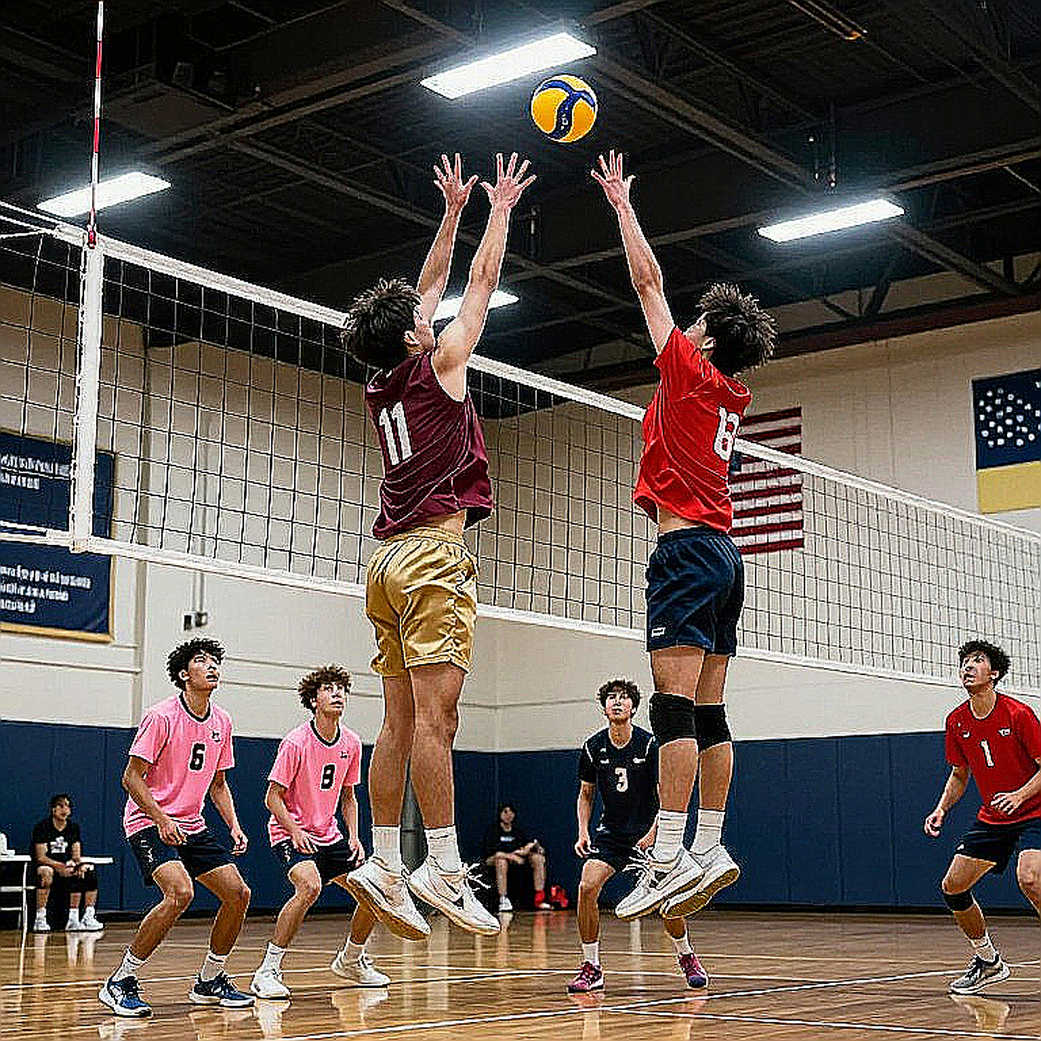
The 2026 edition will be held in Aichi-Nagoya, Japan. The strongest team in Asia plays at home. For a side chasing bronze, that is the least favourable condition available.
The AVC Cup takes place in late June in the Philippines — the only concrete date I have. From there to the Asian Games, the Indonesian men's team enters a continuous training block. Head coach Reidel Toiran said: “We have not stopped until now.”
That sounds like a very positive sentence. It is also a worrying one.
THE BLIND SPOT OF A TARGET
The first thing a journalist does with a stated target is go looking for numbers. I could not find any. Not because I did not try, but because the source did not have them.
In volleyball, each tier of ambition requires a different set of metrics. To win Southeast Asia, you need a stable perfect-pass rate and an outside hitter who scores 20 points a match. To reach an Asian quarterfinal, you need middle blocking and an opposite who stands above two metres. To reach an Asian semifinal, you need all of that plus a libero resilient enough to hold the system together when the opponent serves heavy.
Nothing in the report says which rung Indonesia is on. That is the biggest blind spot: the target is not anchored to a specific level of capability, so it can neither be wrong nor right.
The federation chairman answers his own question — why dare to target bronze? Because of the journey. That is an administrator's answer, not a coach's. It speaks to how far the team has travelled, not to whom it will beat.
Meanwhile the coach uses a different word: “We can make a surprise.” Surprise is the word of a man who knows he is not a favourite. It is an underdog's self-positioning, and it is more honest than the medal target.
THE ARITHMETIC OF A BRONZE MEDAL
Asian Games men's volleyball is typically pool play into knockout. To reach the podium, a team must clear its pool in a high enough position and then win at least two knockout matches.
Count them. The first knockout opponent could be Qatar, a former continental champion. The second could be China or South Korea. To be sure of a bronze-medal match, Indonesia would likely have to beat one of those sides, and in several scenarios both.
This is the kind of problem data can answer — if there is data. With no confirmed schedule, no head-to-head record and no recent form, every calculation is structured speculation. And structured speculation is still speculation.
THE REAL INVESTMENT SIGNAL
The most interesting detail in the whole story is not the target. It is the nationality of the head coach. Reidel Toiran is Cuban.
In world volleyball, a Cuban coach usually brings a specific model: physical priority, high sets, attacking above the block, fast transition after the dig. It is the model that once took Cuban men's volleyball to the top of the world, and it differs fundamentally from the East Asian school, where speed, variation and the passing system are the weapons of survival.
If Indonesia is genuinely shifting toward a physical model, that is a strategically sound bet. Southeast Asian volleyball nations cannot beat Japan or Iran by playing faster than them. Japan is the fastest team in Asia. The only route past them is to become different — taller, stronger, and disciplined enough to hold the system under serving pressure.
But that model has a price. It requires time, a generation of athletes with the corresponding height, and a youth pipeline deep enough to feed it. Nothing indicates Indonesia has those things yet. A foreign coach is a signal of ambition. It is not yet proof of capability.
A rough gem does not lie at the bottom of the court; it lies where nobody looks closely. Here, the rough gem could be a 2.05-metre middle blocker playing in Proliga whom no report bothers to name. But if nobody names him, I cannot write about him either. That is a problem for an entire volleyball ecosystem, not for this article alone.
A PROFESSIONAL SCAR
I carry a scar directly relevant to this.
In 2026 I travelled to Russia for the World Cup at the age of 20. During the match between Russia and Saudi Arabia at Luzhniki, I mispronounced a player's name three times in the first half. I was ashamed enough to spend the following month rewatching footage and transcribing names phonetically. Moscow was not only where I got a player's name wrong; it was where I learned to listen to a person.
That lesson applies here very concretely.
In the dataset I was given, two items are entirely off-topic: an athlete named Sayu Bella Sukma Dewi and a rowing silver medal. Both were attributed to the headline section of a report about Indonesian men's volleyball.
In a sport where every statistic is scarce, information noise destroys the entire basis for evaluation. Had I treated the rowing medal as a fact, I would have written a false article. And if a reader sees that page and assumes Indonesia has just added to its medal tally, the error multiplies.
People call them second-tier teams; I call them pathfinders. But to find a path, the map has to be right. Indonesia's volleyball map currently lacks both scale and coordinates.
THE DOUBLE-EDGED BET OF A CONTINUOUS BLOCK
A training block running from June to the Asian Games cuts both ways.
On one hand, it builds cohesion. For a national team that meets only a few times a year, time together is worth more than any contract. Blocking systems, combinations after the dig, unspoken conventions — these only form when people spend long enough beside each other.
On the other hand, a thin squad cannot absorb that load. Without credible backups, one ankle or patellar tendon injury in week eight can wreck the season. And volleyball is a sport where touch only arrives when you play real matches, against real opponents, under real scoreboard pressure.
Training endlessly together without facing major opposition outside the region is the surest way to enter a tournament with the confidence of a gym and the panic of a stadium.
Across twelve years covering volleyball in Vietnam and Singapore, I have seen this repeat often enough to call it a rule: small volleyball nations tend to use training time as a sedative rather than as a time-limited investment.
The federation simultaneously sending the women's team to the AVC Cup in the Philippines while maintaining the men's training block is another resource signal. For a federation of PBVSI's scale, running two senior national teams in parallel means budget, medical staff and analyst capacity split in half. Nobody says that in the report. But it sits inside every decision that follows.
A SURPRISE IS NOT A PLAN
The most counter-intuitive point here is that the bronze target may not be designed to measure capability at all — it may be designed to mobilise resources.
In second-tier sporting nations, a public target often plays a political role more than a technical one. It justifies a budget. It generates pressure to permit long-term centralisation. It ties a chairman's name to a milestone for later reference.
Read that way, PBVSI's statement is not wrong. It is simply not a forecast.
But there is a structural risk any sports administrator should see: when a target is announced publicly and attached to an individual's name, it becomes a debt. If the team stops at the quarterfinal, the next question will not be “what did we learn” but “who is responsible”. And in Southeast Asian volleyball, the answer to that question is usually the coach — especially if he is foreign.
On the other side sits a stronger argument: a second-tier team needs an out-of-reach target. Without one, the federation cannot secure long-term centralised funding, cannot hire a foreign coach, cannot justify change. The bronze declaration may be a tool for opening doors rather than closing them.
These two readings are not mutually exclusive. The observer's job is not to confuse them.
WHAT TO WATCH
Between now and the Asian Games, four things will speak more truthfully than any declaration.
Indonesia's results against top Asian sides in friendlies. The squad list when it is published, particularly the average height of the blocking line. The AVC Cup in late June in the Philippines, where Indonesia will meet opponents from outside Southeast Asia. And the International Volleyball Federation ranking, where Indonesia's position relative to Asia's top six or seven will show whether bronze is near or far.
LEAVING THE COURT
What is changing in Indonesia is not the target. It is that the federation has, for the first time, hired a foreign coach for the men's team and laid out a dated competition ladder: the AVC Cup in late June, the SEA V Cup, then the Asian Games. That is how a serious volleyball nation operates.
The stadium is empty, but the applause remains — it simply comes from people nobody writes about. Indonesia's women's team departed for the AVC Cup with no medal target attached. Perhaps because nobody dared. Perhaps because nobody has tried.
A volleyball nation that sets a goal for its men with no data behind it, and sets no goal at all for its women, is telling us something about itself. What exactly?