
Antibes U15 opening day: Marcos Gomez unbeaten, but six rounds remain to decide the title
**Core answer** Spain's Marcos Gomez is the only unbeaten player after the opening day of the ETTU Europe Youth Top 10 Under-15 Boys event in Antibes, France, having won all three of his round-robin matches. Six of nine rounds remain, so the title race is still open. **Key facts** - Marcos Gomez (Spain) beat Alexander Malov 4-2, Ondrej Moravek 4-0 and Ladimir Mayorov 4-1 on the opening day. - Four players sit at 2-1: Ladimir Mayorov, Nazar Bakirov, Emil Ellermann and Tien Nghia Phong. - Ondrej Moravek of Czechia is the only winless player, at 0-3 after three rounds. - The ten-player field covers seven associations; Spain entered three players and Germany two. - The event carries no senior world-ranking points and serves as a European youth development benchmark. **Source attribution** European Table Tennis Union (ETTU), Europe Youth Top 10 Under-15 Boys opening-day report, Antibes, France | Cross-checked: VuaBong.vn **Related Q&A** Q: Who leads the Under-15 Boys event in Antibes? A: Spain's Marcos Gomez, the only unbeaten player at 3-0. Q: How many rounds remain? A: Six of nine round-robin rounds remain before the title is decided. Q: Does this event affect senior world rankings? A: No, it is a European youth invitational with no senior ranking points.
Marcos Gomez's opening match in Antibes ran to six games. The Spanish player beat Alexander Malov 4-2, but let his compatriot take the lead early on. The scoreboard records the result; it does not record the seconds between games — Gomez turning his back to the stands, wiping his face with a white towel, the rhythm of the ball against the table slowing. In youth table tennis, those pauses often decide more than a powerful loop. And in Antibes, they revealed a field that nobody truly controls.
After the first three rounds of the ETTU Europe Youth Top 10 for Under-15 boys in Antibes, France, Gomez is the only unbeaten player. He beat Malov 4-2, beat Ondrej Moravek 4-0, then beat Ladimir Mayorov 4-1. Three matches, three different opponents, two of them compatriots. It is the cleanest start in a field of ten players from seven national associations.
But this is a nine-round round-robin. Gomez has completed only a third of the journey. Six rounds still lie ahead, and in European youth table tennis a perfect day has never been a guarantee of a title.
A stage designed to measure depth
The ETTU Europe Youth Top 10 is the European Table Tennis Union's annual stage for the highest-ranked young players on the continent in each age group. This year's Under-15 boys bracket brings together ten faces in a nine-round round-robin, each match a maximum of seven games — first to four games ends it. There are no professional ranking points and no meaningful prize money. The event's value lies elsewhere: it is where European federations measure their own depth, and where fifteen-year-old names are placed side by side on the same draw for the first time.
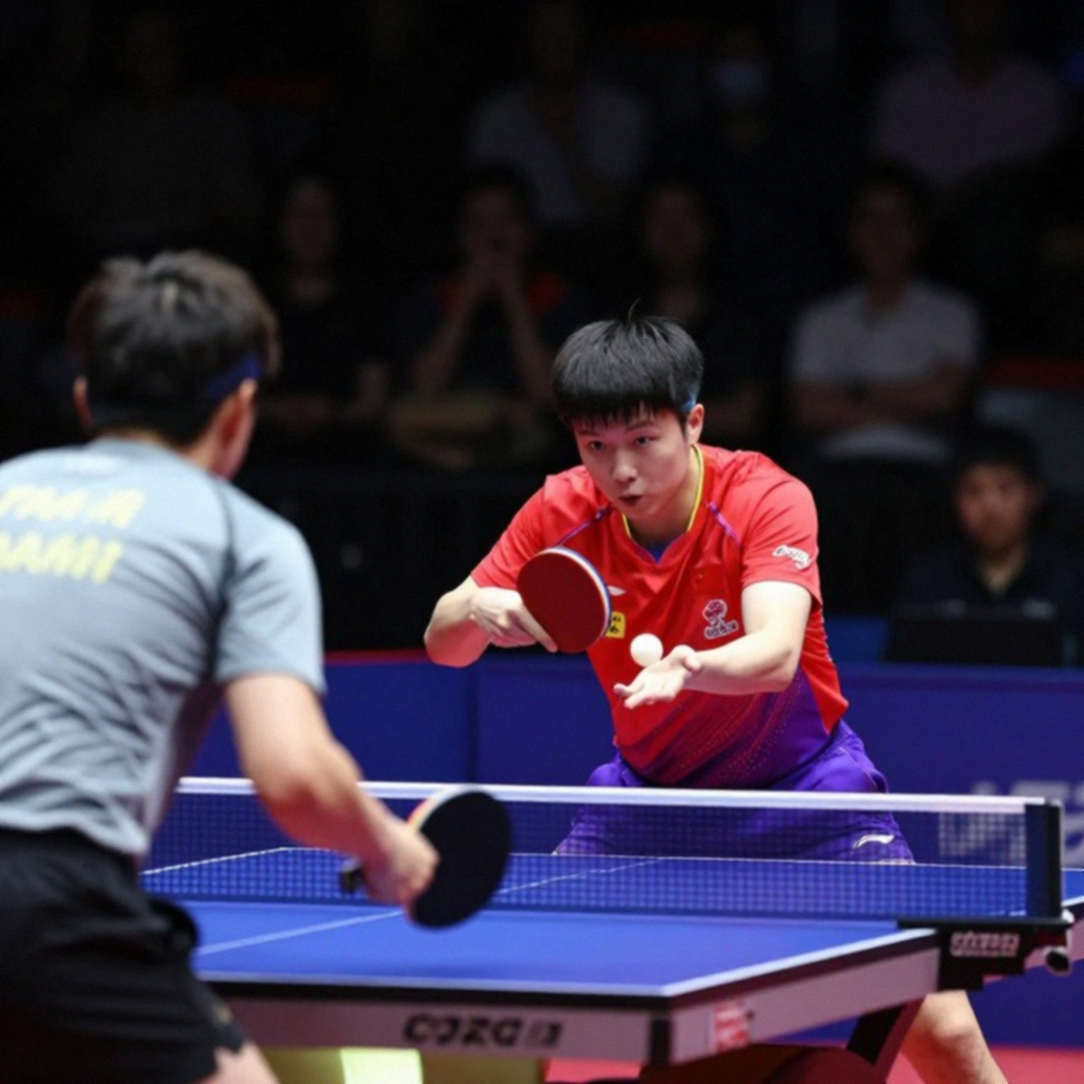
The standings after three rounds show a picture very different from what a "perfect day" usually suggests. Below Gomez, four players sit at 2-1: Ladimir Mayorov (Spain), Nazar Bakirov (Russia), Emil Ellermann (Sweden) and Tien Nghia Phong (Germany). Four others sit at 1-2: Alexander Malov (Spain), Noah Tessier (France), Hubert Kwiecinski (Poland) and Lukas Wang (Germany). Only Ondrej Moravek (Czechia) has yet to win. Ten players, fifteen matches played, and no real gap has formed.

The notable detail lies in the federation structure. Spain contributes three players to the ten-strong field, Germany two; Sweden, Russia, France, Poland and Czechia each send one. Two of Spain's three — Gomez and Mayorov — are in the leading group. In an age group where physical and technical gaps are not yet clearly differentiated, one nation placing three faces in the same draw is a signal about its youth development system, not merely individual luck.
Reading the match through games that flipped
Most of the information from a day like this comes from scores, and the scores in Antibes say one thing clearly: this is a tightly compressed field. Four matches went to a seventh game. Lopsided wins such as Gomez's 4-0 over Moravek or Mayorov's over Malov are the exception, not the rule.
The two most notable matches shared the same script. Emil Ellermann let Moravek lead 2-0, then won four straight games to finish 4-2. Tien Nghia Phong let Bakirov lead 2-0, then also won four straight games, finishing 4-2. In the opposite direction, Bakirov himself — after leading Phong 2-0 — lost four consecutive games and surrendered the match.
Reading these two events side by side, I see a familiar pattern in fifteen-year-old table tennis. When a young player leads by two games, the ability to maintain serve structure and hold the tempo is often unstable. Conversely, when behind, many players free up their arm because there is nothing left to lose. This is why matches at this age have such wide amplitude — and why a first-day scoreboard rarely predicts the eventual winner.
I once mis-recorded three transition phases at a youth event, and the lesson remains intact: the rhythm of a match does not lie in the ball, it lies in the seconds when it stops rolling. In Antibes, those seconds were the moment Ellermann and Phong walked into the third game trailing 0-2. No image in the report shows what they did in that interval. But the score of the next four games is evidence enough to say both found a way to restructure the match.
Gomez's road ahead
Gomez's case is interesting for another reason. The only unbeaten player is also the one who has never been pushed into a genuinely tense game. He won 4-2, 4-0, 4-1 — meaning he has not faced a 0-2 deficit, has not played a deciding seventh game. In a round-robin, that is both an advantage and an unknown. The advantage is that he saves energy and keeps psychological stability. The unknown is that he has not been tested at the exact moment this event will soon create.

He still has to face Bakirov, Ellermann and Phong — three players at 2-1, all of whom have just proven they can flip a match. He must also meet his compatriots again later in the schedule, and internal national-team pressure is always an unpredictable variable. Before the ball rolled in round four, I could already see how this race might fracture from within: through all four players in the 2-1 group winning, turning the final six rounds into a chase in which anyone could stumble.
A first-day lead buys nothing
There is a strong temptation when writing about a day like this: to call Gomez a phenomenon, to call Spain Europe's new youth power, to read 3-0 as the mark of a future champion. I choose not to, and the reason lies in the structure of the data itself.
Three matches is far too small a sample to conclude anything. In a nine-round round-robin, each player contests nine matches; the first three are only a third. Youth table tennis history is full of players who dominated a group stage and then vanished when they stepped onto the adult stage, and equally full of the reverse. Under-15 dominance correlates very weakly with professional success, because these players' bodies, technique and psychology are still changing.
It is also worth looking the source straight in the eye. This is a report issued by the European federation itself, aimed at promoting the event and its young players. Its value lies in its timeliness — it is present exactly while the event is running. But it is not independent analysis, and it acknowledges as much when it states plainly that six rounds remain. The organizers themselves did not rush to crown Gomez; readers should keep a similar distance.
I am not saying Gomez is not a player worth following. I am saying that the value of this name, at this moment, lies in the long-horizon question it opens, not in a short-term conclusion. The distance between those two things is the entire gap between a results report and a tactical analysis.
Three signals to track over the remaining six rounds
The first signal is Gomez. Whether he can keep his perfect record when he meets the 2-1 group — and if he wins, whether he has to go to a seventh game for the first time. A player who has never been tested at this age still carries an undisclosed unknown.
The second signal is Bakirov. A player who loses a match from a 2-0 lead often carries a psychological trace into the following matches. How he responds in round four will show whether the collapse against Phong was a one-day accident or an exploitable weakness.
The third signal is Spain. Three players in a ten-strong field, two in the leading group — whether this is a first-day moment or a sign of a rising development system. In an age group where everything is still taking shape, every round is data rewriting itself. The scoreboard in Antibes today will become meaningless tomorrow if the coming games deny it — and in youth table tennis, that happens more often than people think.
What remains after a day of play
What keeps me with events like the Europe Youth Top 10 is not the result, but the way the result forces a writer to be humble. One day of play yields fifteen matches, and within those fifteen there are only a few patterns clear enough to name — the comeback ability of Ellermann and Phong, the fragility of a 2-0 lead, and a Spanish player standing above everyone yet never truly tested.
The remaining six rounds will do the rest of the work. And if one of the names in Antibes appears on the senior European stage within the next five to eight years, we will remember this first day — not for who led, but for who lasted to the end. An injury is only a story; a fifteen-year-old's journey is the real long investigation.