
Trang chủMartial ArtsThe Unanimous 5-0 Slip and the Synchronized Breath: How Vietnam's Women's Team Kata Read the Match Before the Judges Did
Martial Arts
The Unanimous 5-0 Slip and the Synchronized Breath: How Vietnam's Women's Team Kata Read the Match Before the Judges Did
**Câu trả lời cốt lõi:** Đội kata đồng đội nữ Việt Nam gồm Nguyễn Ngọc Trâm, Bùi Ngọc Nhi và Hoàng Thị Thu Uyên đã giành huy chương vàng đầu tiên cho đoàn Việt Nam tại kỳ đại hội châu Á, thắng Iran 5-0 với cả năm giám khảo chấm điểm Việt Nam cao hơn. **Dữ kiện chính:** - Kết quả chung kết kata đồng đội nữ: Việt Nam thắng Iran 5-0, đồng thuận cả năm giám khảo. - Đây là tấm huy chương vàng đầu tiên của đoàn Việt Nam tại kỳ đại hội lần này. - Nguyễn Ngọc Trâm bị sưng và trầy đầu gối trong khởi động nhưng vẫn thi đấu. - Mức thưởng khoảng 1,2 tỷ đồng từ nguồn nhà nước và xã hội hóa. - Kata không có hạng cân, không có nguy cơ tổn thương não do va chạm lặp lại. **Nguồn:** Tổng hợp báo cáo sự kiện Asian Games, công bố trong kỳ đại hội | Đối chiếu chéo: VuaBong.vn **Hỏi đáp liên quan:** - Hỏi: Kata đồng đội nữ khác gì với karate đối kháng? Đáp: Kata là môn biểu diễn được hội đồng giám khảo chấm điểm theo tiêu chí kỹ thuật và thể chất, không có va chạm hay hạng cân. - Hỏi: Vì sao tờ phiếu 5-0 quan trọng? Đáp: Năm trên năm giám khảo đồng thuận cho thấy khoảng cách rõ ràng về chất lượng trình diễn, không phải phán quyết gây tranh cãi. - Hỏi: Vị thế Olympic của karate hiện ra sao? Đáp: Karate có mặt tại Tokyo 2020 nhưng bị loại khỏi Paris 2024 và Los Angeles 2028, khiến đấu trường châu lục trở nên quan trọng hơn.
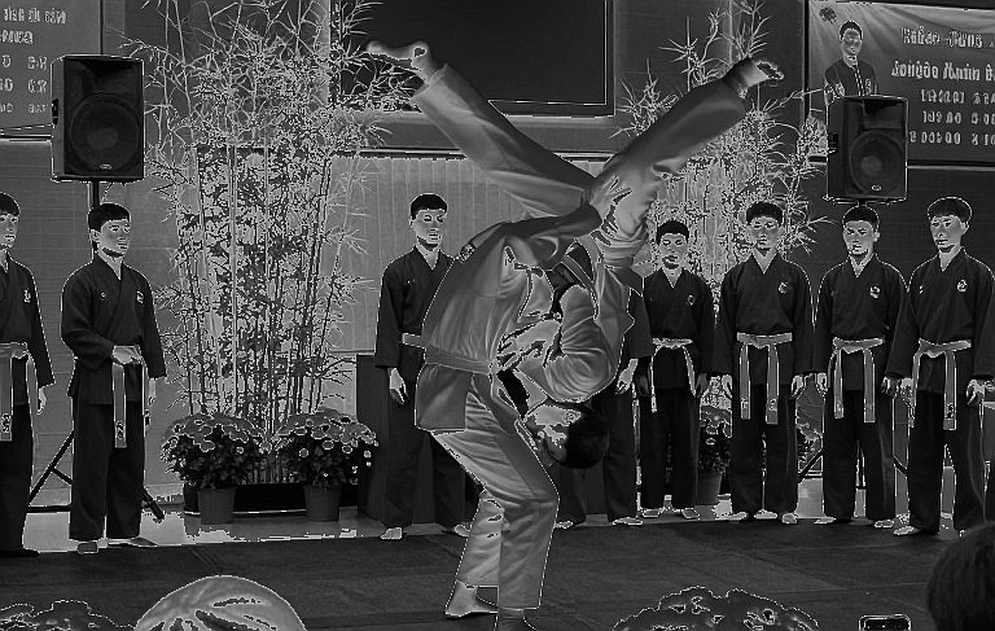
Three Vietnamese female athletes stood off the mat, hands clasped, breathing in a single rhythm. On the mat, Iran had just finished its routine. There was no shout, no celebration. Just four hands gripping each other and a breath adjusted so that all three could enter the same state. When I replayed this footage again and again, what I counted was not kicks or punches. I counted how many times the three athletes caught each other's eyes, the shared breaths, and the silence before stepping onto the mat. Kata is a judged performance discipline, where the outcome is decided by a panel of judges, not by the number of techniques that land.
When the final slip was announced, Vietnam beat Iran 5-0. Five out of five judges scored Vietnam higher. I don't watch the goal; I watch the camera angle that watches the goal. In kata, the "goal" lies in the moment the judges raise their scores in unison, and that moment, within a sport notorious for controversial rulings, is one of the clearest signals a competition-discipline reporter can record. The first gold medal for Vietnam's delegation at this edition of the Games went to a performance discipline, not a combat one. That alone deserves analysis.
Three names must be written in full: Nguyen Ngoc Tram, Bui Ngoc Nhi, and Hoang Thi Thu Uyen. They are three halves of a single block on the mat, where a single misbeat by one pulls down the whole routine. Before the final, Ngoc Tram struck her knee twice during the warm-up, causing swelling and an abrasion. She competed anyway. In the waiting area, the team was so tense that no one dared speak. These details sound small, but they are the raw data for re-reading the entire match.
To understand why the 5-0 slip carries such weight, it must be placed in the correct rule frame. Team kata sits within the competition rules of the World Karate Federation (WKF). The judging panel evaluates against two groups of criteria: technical and athletic. The technical group covers precision of stances, synchronization, power, rhythm, breath control, and what is called kime, the decisive focus at the end of each technique. The athletic group covers strength foundation, speed, flexibility, and the ability to hold body structure throughout the routine. This is why a 5-0 slip in kata cannot be read like a 50-45 score in boxing. Here, it means five independent judges all saw a clear gap in technical and athletic quality on the day.
Kata has no weight classes. There is no weight to cut, no dehydration to make the scale, no pressure to shed kilograms within twenty-four hours. This changes the entire nature of an athlete's career risk. There is no cumulative head trauma, no risk of brain injury from repeated impact. The main risk lies in joints and soft tissue: knees, hips, ankles, from deep stances and repeated torque over thousands of training hours. The swelling and abrasion on Ngoc Tram's knee during warm-up falls squarely in this risk group. It is minor, but it tells a story.
I have spent years logging every referee decision that was overturned, starting from a notebook that only recorded notes on video-assistance technology. And I learned one thing: data never makes a mistake; the writer is the one who gets the card. When reading a kata result, the most common error is applying combat logic to a performance discipline. There is no knockout rate, no takedown defense, no absorbed strikes here. What is measurable is the degree of synchronization between three people, and what the 5-0 shows is that this synchronization reached a threshold all five judges registered.
There is a notable tactical detail about the order of performance. Vietnam performed after observing Iran from outside the mat. That gave Vietnam a target to beat and a psychological anchor. In a judged discipline, knowing exactly what the opponent did is a double advantage: it provides information and creates pressure. The team performing second faces pressure to surpass, but also enjoys the advantage of witnessing mistakes. That order turned Vietnam's routine into an answer, and within an answer, people tend to concentrate on the points most vulnerable to judgment.
The hand-holding and breath-regulating ritual before entering the mat, from a sports-psychology perspective, is precisely a mechanism for synchronizing the nervous state of all three. A team kata fails when the three biological rhythms drift apart, even if each individual's technique is good. Their way of holding hands and breathing together is a form of temporary collective leadership, where no one commands but all three settle into one rhythm. On replay, I realized that silence was the hardest part of the whole routine.
Before the final, the team was in a state of extreme tension. Accounts show no one dared speak because they were too nervous and worried. The pressure came not from winning gold for the first time, but from having to keep it. The phrasing "defending the title" indicates this was a medal asset treated with intent, with continuity in selection. That upgrades the reading of the result from "breakthrough" to "sustained excellence." A team can win once on form, but holding the title across the next cycle requires a system.
When discussing organizational structure, one must look at the power diagram behind the medal. The Olympic Council of Asia and the Games organizers set the event and reward policy. The World Karate Federation and the Asian Karate Federation govern the rules and judging. The Vietnam Karate Federation and the national delegation handle selection, training, and state bonuses. And at the end of that chain are three specific people stepping onto the mat. Understanding this chain helps explain why the first gold medal matters so much to the whole system: it is a morale-setting signal for the entire delegation early in the Games.
The reward of roughly 1.2 billion VND, assembled from state and socialized sources, reflects a state-led incentive model topped up by sponsors and community contributions. Split evenly among three athletes, it comes to a few hundred million VND each, roughly fifteen thousand US dollars before any separate allocation to coaching staff. The conversion rate must be verified against the transaction date. More important than the figure is its nature: this is a one-time reward, not recurring income. It honors the achievement, but it does not create a profession.
In sports-economics terms, women's team kata does not sit within a pay-per-view economy. There is no ticket revenue, no large personal endorsement package in a market dominated by football. The commercial value of the athletes is far below their competitive value. A single Asian Games gold rarely creates lasting brand value without another podium at continental or world level, or a move into media and coaching.
One systemic factor complicates this story. Karate's status in the Olympic program is fragile. It was added for the Tokyo 2026 Games, then dropped for Paris 2026 and Los Angeles 2028. As a result, continental Games and world championships become the primary shop window, making an Asian Games gold more significant than usual. For a kata specialist, the big stage narrows, and each Games becomes an opportunity that cannot be missed.
When I replayed Iran's routine, I did not see a weak team. Iran is a recognized kata power in Asia. Their 0-5 loss does not mean they are structurally inferior. In kata, one-sided unanimous slips usually reflect a gap in discipline on the day, not an essential mismatch. I have no data on criterion scores, the chosen kata name, or the application demonstration. Without that data, any claim about how much better Vietnam was is speculation.
This is what I want to make clear as a competition-discipline reporter. We can state the gap was clear because five out of five judges agreed. We cannot state the gap was wide or narrow. Unanimity only shows the direction of the verdict, not the amplitude. That is the limit of public data, and the writer must respect that limit rather than fill it with emotion.
On the health dimension, a kata athlete's risk profile is fundamentally different from a combat athlete's. There is no cumulative head impact, so no risk of neurological injury from repeated force. The main risk is joint and soft-tissue degeneration from high torque on knees, hips, and ankles over many years. There is also the psychological risk of a judged discipline: a sense of dependence on others' verdicts, pressure to be perfect every second, and fear of a misbeat. Ngoc Tram's knee injury is a small but telling signal: it happened during warm-up, suggesting possible gaps in warm-up protocol or mat conditions.
On the legal and compliance dimension, this result is clean. No violation is alleged, no protest over judging, and the disbursement of the reward shows the result stood. Doping testing is not mentioned, and under World Karate Federation and Games rules, in-competition testing is standard. We should treat this as an information gap, not a red flag. Kata has no weight classes, so there is no scale risk. This is a major difference from combat disciplines, where the scale is often where the most serious incidents arise.
There is a common assumption this result overturns. People tend to think combat disciplines will bring a delegation its first medals, because they draw attention and carry symbolism. But at this edition, a performance discipline, a non-contact one, was where Vietnam opened its gold account. Women's kata took the first gold. That shows a delegation's investment and selection structure does not always follow the spotlight.
Another assumption to challenge is the link between unanimity and dominance. In combat-fan thinking, five out of five is usually read as absolute dominance. In kata, it is the panel's consensus. These concepts differ. Consensus reflects that no judge saw reason to rank the opponent higher. It measures clarity, not distance. A routine marginally better but clear can earn five out of five. A routine much better but controversial can earn three out of two. So reading the 5-0 slip as an index of amplitude is a methodological error.
One must also speak of the price of perfection. Kata is the discipline where every second can be re-evaluated. There is no extra round to fix mistakes, no second leg for revenge. The routine lasts a few minutes and ends, and that is that. Judges in judged disciplines live in a space where decisions cannot be reversed by time. The law is the only thing that never enters stoppage time, and in kata, stoppage time simply does not exist.
What struck me most on replay was the psychological preparation. A team so tense it went silent, then self-corrected through a shared ritual. That is evidence of relatively good psychological support, or at least a collective mechanism formed to resist distraction. In a judged discipline, where there is no direct opponent to react to, the greatest enemy is internal misbeat. Three people breathing together is how you erase that misbeat before it forms.
I once wrote that a referee's mistake is a window, not an error. Here, the interesting thing is there was no mistake to dissect. The clean slip forces the writer to move from analyzing errors to analyzing the clarity of a correct decision. This is a different exercise, and it is harder. When there is no controversy, the writer loses the anchor, and it is easy to slip into praise instead of analysis.
A question of sustainability sits behind the medal. A one-time reward, however generous, does not replace recurring income. For a kata athlete, the post-competition path usually leads to coaching, refereeing, or teaching. Without a transition system, the risk of an income cliff after retirement is real. This is a structural weakness of many amateur Olympic-track sports, and kata is no exception.
There is another data gap I cannot fill: the athletes' ages and birthdates. Without that, one cannot place them at the right stage of the career curve. Kata, biologically, allows a career to last far longer than many combat disciplines, since it depends on technique rather than peak reflexes and chin durability. A kata athlete can compete at the top into the late thirties. If this trio has held the title for at least one cycle, they may be near peak maturity.
On the opponent side, I want to give Iran a fair word. A 0-5 loss before a panel says nothing about the weakness of a karate system. It says that on that day, a gap was clearly seen. Kata is a discipline where form is recreated each time on the mat, not accumulated like points over a season. This is what makes it closer to performance art than combat sport, and also what makes it hard to predict.
I have built models predicting referee behavior from historical data, and I have watched them collapse because of psychosocial variables that do not exist in a spreadsheet. My faith in purely data-driven models has been tested. Looking at this 5-0 slip, I remind myself that behind every number is a panel of human beings, with crowd pressure, with memories of past criticism, and with a need to be seen as clear. A unanimous verdict is not only the result of routine quality; it is also the result of a desire to avoid controversy.
The referee is the fastest reader of the match; I am only one beat slower. And in this case, I am slower than even the shared breath of three women standing off the mat, hands clasped. What I saw through the screen was not dominance, but unity. A unity built beforehand, not born on the mat.
Discipline is not punishment; discipline is a way of reading the match. For Vietnam's women's team kata, discipline showed in all three choosing one rhythm, knowing where they stood in a judged system, and holding that structure even when a knee swelled during warm-up. That is a form of discipline that cannot be measured by falls to the mat, but by the times none of the three drifted out of line.
Looking at long-term development, this gold medal raises a question about the selection and reward model. When a discipline without stable Olympic status brings home the opening gold, the delegation has a chance to rethink how it allocates resources. I believe the value of this result lies in opening a discussion about properly valuing disciplines with narrow competition windows and distinct career spans.
On the rules side, the kata judging panel should be an area of greater transparency. Publishing criterion-by-criterion scores, even after the event, would help athletes and the public understand why a routine won and by how far. This is how you move from belief to evidence in a discipline where subjective verdicts are always sensitive. Today's 5-0 consensus is a good foothold to start from.
I don't watch the goal; I watch the camera angle that watches the goal. And the camera angle here showed me something simple: three Vietnamese female athletes stepped onto the mat on a single breath, and left the mat with a single slip. Between those two moments were a swollen knee, a silence so deep no one dared speak, and a decision by five people that no one opposed. If you want to understand what truly makes a first gold medal, start with the breath, not the kick.

Cầu thủ liên quan
Bài đề xuất
Reading Vietnam's Women's Team Kata Gold at Asiad 20 Through Five Judges' Flags2026-09-23
Cannot create article due to missing source content2026-09-06
The Unanimous 5-0 Slip and the Synchronized Breath: How Vietnam's Women's Team Kata Read the Match Before the Judges Did2026-09-23
The Inam Butt File: A Short Ban, a Stripped Silver and Pakistan Wrestling's TUE Blind Spot2026-09-15
Inam Butt and the Small Prescription Pulled Off the Medal Board: A System Recalibrating Its Own Weight2026-09-16
Bài đề xuất
Empty Dossiers in Transfer Season: Vietnam's Combat Sports and the Lesson of Verification2026-09-11
Vietnam at the 2026 World Taekwondo Poomsae Championships in Chuncheon: When Gold Comes from the Collective, Not the Star2026-09-13
The Map of 20+ Global MMA Championship Belts: Why "Champion" No Longer Measures the Same2026-09-15
Thirty Minutes in the Sauna and a Forfeited Quarterfinal Ticket: Decoding the Weight-Cut Incident at the 2026 Asian Games2026-09-22
Three Days of Rewatching Tape: What Is Really Happening in Vietnamese Martial Arts2026-09-12
Bài đề xuất
Vietnam's taekwondo squad at ASIAD 2026: A two-blade structure and a silence nobody probes2026-09-17
The Empty Chair in the Martial Arts Analysis Room: When Data Goes Silent and the System Misreads Us All2026-09-12
Sports Analysis: Insufficient Information to Create Article2026-09-09
Vietnam Taekwondo bets on 'collective strategy' at 2026 World Championships: In-depth analysis of gold opportunities from four perspectives2026-09-14
The Inam Butt File: A Short Ban, a Stripped Silver and Pakistan Wrestling's TUE Blind Spot2026-09-15