
Reading Vietnam's Women's Team Kata Gold at Asiad 20 Through Five Judges' Flags
**Câu trả lời cốt lõi:** Đội kata đồng đội nữ Việt Nam giành huy chương vàng tại Asiad 20 sau khi thắng cả ba trận loại trực tiếp với tỷ số 5-0 từ năm giám khảo, lần lượt vượt qua Nepal, Đài Bắc Trung Hoa và Iran. Kata là nội dung biểu diễn do giám khảo chấm điểm, không va chạm, khác với kumite. **Dữ kiện chính:** - Ba vận động viên: Nguyễn Ngọc Trâm (24 tuổi), Bùi Ngọc Nhi (19 tuổi), Hoàng Thị Thu Uyên (20 tuổi). - Thắng Nepal (tứ kết), Đài Bắc Trung Hoa (bán kết), Iran (chung kết), đều với tỷ số 5-0. - Biên độ điểm chung kết 0,3-0,7; bán kết hẹp hơn, 0,3-0,4. - Số đội dự nội dung tăng từ 4 (Asiad 19) lên 8 (Asiad 20). - Huấn luyện viên thay đổi sau Asiad 19; Nguyễn Hoàng Ngân là cựu huấn luyện viên. **Nguồn:** Báo cáo kết quả Asiad 20, nguồn và ngày đăng chưa xác minh; dữ liệu điểm do giám khảo cuộc thi công bố, chưa có biên bản kiểm chứng độc lập | Cross-checked: VuaBong.vn **Hỏi đáp liên quan:** Hỏi: Kata đồng đội khác kata đơn thế nào? Đáp: Đội ba người phải trình diễn đồng bộ, và sự đồng bộ là yếu tố chấm điểm quyết định. Hỏi: Vì sao tỷ số 5-0 lại quan trọng? Đáp: Vì cả năm giám khảo cùng xếp Việt Nam trên đối thủ, cho thấy khoảng cách thực thi rõ rệt. Hỏi: Karate có còn trong chương trình Olympic không? Đáp: Karate bị loại khỏi Paris 2024 và Los Angeles 2028, khiến Asiad trở thành đấu trường hàng đầu của bộ môn này.
Three pairs of bare feet touched the floor almost in the same instant. No chant, no count. Only breath held in, then three bodies pulling back in a rhythm the eye could not separate. At the judges' table, five arms rose almost simultaneously, and every one pointed the same way.
I have sat at enough martial arts floors to know that the moment five flags refuse to waver is the real story. The gold medal is only the visible consequence. The decision lies elsewhere: in the almost unbelievable agreement of the people seated above, pen in hand and eyes fixed on three figures moving as one.

The truest pulse is not in the stands; it lives under the feet of those early morning training sessions. And in team kata, that pulse must match down to the smallest fraction of a second, or everything collapses right in front of the panel.

The women's team kata final at the 20th Asian Games ended with a result the scorecard states better than any commentary: Vietnam beat Iran outright. But to grasp why that result matters, it must be placed in the right type of competition.
Kata is a performed-routine, judge-scored discipline with no contact at all. It differs in essence from kumite — the sparring category where two athletes fight and the winner is decided by landed strikes. In kata, nobody fights anyone. Each team performs independently, then the panel compares and ranks them. The outcome lives on the scorecard, not on the opponent's body.
But that Asiad 20 night carried a structural oddity. In wushu taolu — a performed discipline with close kinship to kata — athletes usually all compete at the same time, queue for scores, and are added up. Here, team kata was run as a direct-elimination bracket, exactly like kumite. That means each team had to step out, perform, win, and step out to perform again. There is no saving your best form. Three matches in one day, three times recreating that perfect pulse.
This hybrid structure is the single most important fact for reading the result. It turns team kata from a discipline of one beautiful explosion into a discipline of repetition. And repetition, as I learned over years on the edge of training floors, is always harder than a single flash.
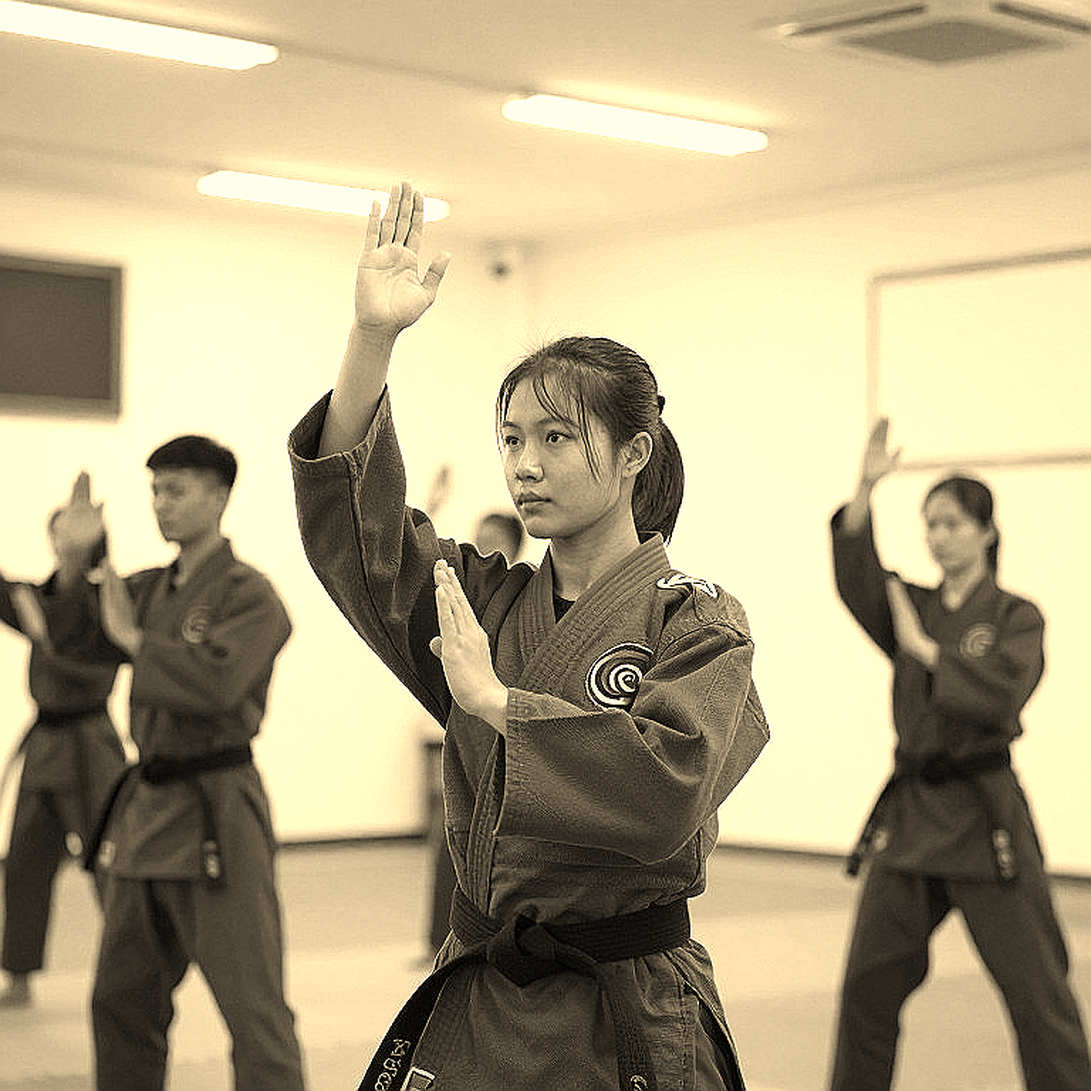
In the quarterfinal, Vietnam faced Nepal and won 5-0. To anyone unfamiliar with kata rules, that sounds like a basketball blowout or a whitewash tennis set. But 5-0 in kata means something else entirely. It means five judges, each asked to rank one team above the other. All five placed Vietnam on top. Not a single flag leaned toward the opponent.
I count the footfalls of three girls in a training session I once watched at a coastal training centre years ago, and I understand why the panel was so unanimous. Synchronisation in team kata is not three people doing the same thing. It is three people existing inside a single span of time. If one drifts half a beat, the whole composition trembles, and the judges' eyes — trained to catch the smallest deviation — will seize on it instantly.
The semifinal is where I paused longest when rereading the scorecard. Vietnam beat Chinese Taipei, again 5-0. But the margin was clearly narrower than the final: each judge's gap sat around 0.3 to 0.4. Chinese Taipei is a familiar power in Asian karate events, not a comfortable opponent. That 5-0 against them is a shield, but a thinner shield than the 5-0 in the final. Read only the 5-0 on the board and the two matches look identical. The judges' cards say the opposite.
This is where I want to pause, because it is the core of any kata analysis. In a subjectively scored discipline, 5-0 does not measure absolute distance. It measures relative consensus. Vietnam may have edged Chinese Taipei by only a sliver on each card, yet that sliver was enough for all five judges to point one way. In the final, the gap was wider, from 0.3 to 0.7 depending on the judge. So the final was genuinely more comfortable than the semifinal, even though both are recorded as 5-0.
Iran reached the final by eliminating Thailand and the Philippines — opponents with real quality, not walkovers. But against Vietnam, they were placed below on every card. When an opponent who has beaten several other teams is unanimously ranked lower, we are talking about a gap in execution quality, not one judge's personal taste. That is the difference between winning by persuasion and winning by luck.
Vietnam's women's team kata won all three knockout matches — quarterfinal, semifinal, final — with a 5-0 score against every opponent. In a subjectively scored discipline, the total consensus of all five judges across a single competition day is the strongest evidence a team can produce. It does not merely say the team was better. It says the team was better beyond dispute.
But there is another layer of data the scorecard does not directly display: rhythmic endurance. Three performances in one day, each required to hold the exact synchronisation trained over months, under the pressure of knowing a single off-beat can bring it all down. This is a variable that single-run performed disciplines do not have. Team kata at this event did not reward the highest peak. It rewarded consistency at the peak — and Vietnam answered that question three times in the same day.
This year's field was also entirely different from three years before. At Asiad 19, women's team kata had only four teams. By Asiad 20, that number rose to eight, with entries such as Iran, Chinese Taipei, and Macau. Defending gold against a field twice as wide carries different weight from defending it against the old field. The arrival of new teams did not just make the event bigger. It made the competitive floor harder, and turned Vietnam's win from a familiar outcome into a statement.
I want to make this plain, because many sports readers will see the word defending and automatically discount its value. In disciplines where ranking depends on consistency rather than explosion, defending a summit is harder than reaching it the first time. The first time, the whole team gambles on one moment. The next time, they must live with that label for three years, with every eye fixed on whether they can still hold the rhythm. At 19 and 20, two of Vietnam's three athletes have not yet reached this discipline's peak.
Three people, three different trajectories. Nguyen Ngoc Tram, 24, was once the youngest member of the Asiad 19 gold squad. Three years later, she is the eldest of the three. She has bridged two cycles, watched the old class leave and the new one arrive. In a discipline where experience accumulates session by session, Tram standing between two generations is a notable datum: she is the bridge between two Asian Games, the one holding the rhythm for the whole group.
Bui Ngoc Nhi, 19, and Hoang Thi Thu Uyen, 20, are at the early part of a curve still rising. In kata, this age is usually pre-peak. A performed-routine discipline matures more slowly than sparring, because it depends on skill, on the ripeness of a sense of rhythm, and on the number of years spent repeating the same movement. If the two are still before their peak, the Asiad 20 gold carries a double meaning: a complete victory today and a foundation for coming cycles.
This year's squad differs almost entirely from three years ago. Two of the three Asiad 19 members have left. Tram is the only survivor. And it is not just personnel that changed. The team's leader changed too. The Asiad 19 coach was Nguyen Hoang Ngan — a female martial artist long regarded as Vietnam's number-one women's kata expert. At Asiad 20, that role was held by someone else.
This is where I want to spend a few lines, because it sits in a zone the media usually skips. Team kata is a discipline of collective memory. The team's entire value lies in synchronisation, and synchronisation is a time-dependent skill built through thousands of repetitions together. When two-thirds of the squad and the leader both change, everything that made that pulse must be rebuilt from scratch. That Vietnam still kept gold after such a turnover in personnel and coaching is a signal about system depth, not the tale of one outstanding individual.
But here a gap in information appears that I want to state plainly. The name of the current coach is not given in the result report. Meanwhile, the name of the former coach — no longer leading the team — is mentioned alongside a fine title. That is an imbalance in storytelling: the current guide is absent exactly at the moment their role matters most. In a discipline whose technique depends directly on the person at the floor's edge, not knowing who leads the team is a significant blind spot.
I have always believed that anyone writing about martial arts must distinguish what they know from what they want to believe. This event has concrete scoring data — judge names are listed as N/A, but the ranking result is clear. Here every score cites the competition judges as its source, yet there is no independent verification record, no named outlet that first published it. That is a gap in sourcing standards, and I am old enough not to erase it merely because the story sounds good.
There is one more small doubt about personnel. The Asiad 19 roster is said to include a member named Luu Thi Thu Uyen, while the Asiad 20 roster includes Hoang Thi Thu Uyen. The two names share the two words Thu Uyen. Most likely these are two different people, and the most reasonable reading is to treat them as separate individuals. But in an article where every detail about who is a newcomer matters, the existence of a possible transcription error is something I would rather leave open than mislabel.
What I want to say does not stop at one medal. The larger context of this story lies in karate's place on the world sports map. After a single appearance at Tokyo 2026, karate was removed from the Paris 2026 and Los Angeles 2028 Olympic programmes. That means for kata athletes, the Asian Games is becoming the almost sole top stage where a continental gold truly carries international weight. When the Olympics closes its door, the Asian Games becomes the largest remaining one.
And this is why Vietnam defending its title matters so much. In a sport pushed out of the Olympic spotlight, a nation repeatedly producing continental-standard kata teams says something about its training system, not just about a few talented individuals. One medal can be luck. Three medals across three consecutive editions, with almost wholly different squads, begins to look more like a process than a beautiful accident.
After a media shock, people do not need another angle; they need a shoulder. But in this case, what is needed is the opposite: a cold technical angle, because the emotional story is already too easy. The gold medal speaks of joy. The scorecard speaks of quality. And we only truly respect the winner when we read the scorecard before the applause.
One more thing anyone following Asian martial arts knows: continental kata has for years been the playground of East and Southeast Asian nations. The field at Asiad 20 expanding to eight teams, with newcomers like Iran, Chinese Taipei, and Macau, is gradually flattening that divide. For Vietnam, this expansion is a double-edged sword. It makes the gold more prestigious and the path to defending it next time far harder. If kata powers such as Japan appear in coming editions, the floor will shift again.
Above all, this is the story of a sport whose value lies outside the professional entertainment market. No huge prize money, no television contracts, no betting market for amateur performed kata. The athletes represent national federations, and their real reward lies in state bonuses, in study places, in future seats inside the coaching machinery. This is a sport where the measure of success is not a fee, but continuity.
Commercial value sits with the nation, not the individual athlete. Vietnam's first gold at Asiad 20 is not an entertainment product. It is national sporting capital, an indicator of a federation's and a youth-development system's effectiveness. For sports managers, the interesting question is not which draft programme gets priority, but what it says about whether Vietnam can repeat this feat several more times.
At 62, I have learned that time does not make a team older; it only makes the story thicker. And the story of Vietnam's three kata girls is exactly the kind that thickens rather than fades. Three years after the Asiad 19 gold, they still stand atop the continent, with a field twice as wide and an almost new squad. That says their system is working, and their rhythm is passing from one generation to the next.
But that rhythm must be read with a technical eye, not an emotional one. Three appearances in one day, three times holding synchronisation under the eyes of five judges — that is an achievement of repetition rather than of one soaring moment. And in a discipline where judges are the final arbiters, the total consensus of the whole panel — in all three matches — is the most precious asset a team can build.
WHAT TO TRACK NEXT: the entry lists for women's team kata in coming editions will show whether the door keeps widening; the presence of teams such as Japan will reshape the entire floor; and the identity and coaching philosophy of the current leader will be the missing piece to understand this story fully.
One question still hangs: if the Olympic stage has closed on karate, where will these three girls keep proving their rhythm is real, and do we have the patience to wait with clear eyes?