
Trang chủTennisSiniakova and Townsend Complete Career Grand Slam: How the Art of Reversal Redefines the Standard of Women's Doubles
Tennis
Siniakova and Townsend Complete Career Grand Slam: How the Art of Reversal Redefines the Standard of Women's Doubles
**Core answer:** Katerina Siniakova và Taylor Townsend giành chức vô địch đôi nữ US Open 2026 với chiến thắng 5-7, 6-0, 6-2 trước Ashlyn Krueger và Robin Montgomery trong 1 giờ 53 phút, hoàn tất Career Grand Slam cho bộ đôi hạt giống số một. **Key facts:** - Siniakova và Townsend là hạt giống số một; Krueger và Montgomery vào chung kết bằng suất đặc cách. - Chung kết diễn ra trên sân Arthur Ashe chiều thứ Sáu, kéo dài 1 giờ 53 phút. - Cặp vô địch thắng 12 trong 14 game cuối cùng sau khi thua set đầu 5-7. - Siniakova hoàn tất Career Grand Slam lần thứ hai, sau bộ sưu tập cùng Barbora Krejcikova. - Đây là Grand Slam cuối cùng trong năm, thuộc chuỗi giải cứng Bắc Mỹ. **Source attribution:** WTA (official), US Open 2026 women's doubles final report | Cross-checked: VuaBong.vn **Related Q&A:** - Hỏi: Siniakova đã từng vô địch Grand Slam đôi nữ với ai? Đáp: Cô hoàn tất bộ bốn Grand Slam đầu tiên cùng Barbora Krejcikova trước khi lặp lại với Taylor Townsend. - Hỏi: Krueger và Montgomery vào chung kết bằng cách nào? Đáp: Họ nhận suất đặc cách của ban tổ chức US Open và tiến tới trận đấu cuối cùng trên sân nhà. - Hỏi: Trận chung kết kéo dài bao lâu? Đáp: Ba set trong 1 giờ 53 phút, theo dữ liệu công bố của WTA.
The scoreboard at Arthur Ashe read 5-7 on Friday afternoon, and in that moment, none of the tens of thousands in the stands realized they were witnessing one of the most symbolically significance reversals in women's doubles of the decade. Katerina Siniakova stood at the baseline, gripping her racket, eyes fixed toward the stands. Taylor Townsend sat down, drank water, said nothing. The opening 47 minutes of the US Open women's doubles final had passed in heavy silence, the top seeds pushed into chase mode by a wild-card pairing. I stayed long after the match ended, rewinding the footage of the first set, and what made me pause was not a shot but the silence between the sets. It was the silence of a tactical restructuring, and from here, the story of this title can only be told in that sequence.
The context of this final deserves careful placement. This is the last Grand Slam of the year, staged at the tail end of the North American hard-court swing, when every player has already been through more than two months of continuous competition on a medium-fast surface. The New York hard court places the highest premium on serve, return, and the first volley, ideal conditions for a net-first pair. Siniakova and Townsend entered as the top seeds, ranked on a 52-week points table rather than a single event. Across the net, Ashlyn Krueger and Robin Montgomery received the tournament's wild card, an administrative decision that delivered them to a home Grand Slam final.
What stands out is Siniakova's achievement architecture. The Czech player had already completed all four majors with Barbora Krejcikova, and now she repeats the feat with a partner entirely different in style. In modern women's doubles history, the number of players who have completed two career Grand Slams with two different partners can be counted on one hand. That feat carries a clearer technical message than any emotional embellishment: Siniakova's skill set is portable, not dependent on a specific partner. It is the kind of capability coaches call system-independent, something built only after years of foundational work at the highest level.
Taylor Townsend took a different road to the same destination. She was once the world's top junior, expected to become a singles star, then shifted to doubles when her singles career did not follow the projected arc. This title, therefore, carries the character of a professional vindication, built through years of patience rather than a single breakout night. A left-hander with impressive movement and net attack, paired with a right-hander possessing exceptionally delicate hands at the net, creates the classic doubles geometry: mirrored left-right, with coordinated forehands crossing the middle.
That geometry is not merely aesthetic. In doubles, the positioning and rotation of two players determine the entire space opponents can exploit. When a left-hander stands on the right half and a right-hander on the left half, the opponent's cross-court returns will always land into one player's dominant hand. The Krueger-Montgomery pair, with two right-handers playing a power-and-net-attack model, faced a problem not every young player is trained to solve at Grand Slam level.
Purely on the scoreboard, the match unfolded as follows: a first set lost 5-7 in a tight contest, a second set won 6-0 outright, a third set won 6-2. In total, the top seeds claimed 12 of the final 14 games. This is the textbook reversal pattern any analyst recognizes immediately: a first set lost in balance, then a complete shift in control. The total match time of 1 hour 53 minutes across three sets is short by Grand Slam women's final standards. That brevity says this was not a marathon rally match but a match of decisive strikes, where serve and the first volley settled points.
As a live observer, I see two ways to read this scoreboard, and both have value. The first emphasizes psychology: a young pair reaching their first Grand Slam final on Arthur Ashe might collapse after winning the first set, as home-crowd expectations suddenly fall on their shoulders. The second emphasizes tactics: the top seeds adjusted their return positions, increased poaching frequency across the middle, and deliberately applied pressure on one opponent throughout the second set. Both readings lead to the same conclusion about rhythm, though they differ on cause.
Process data from this match was not fully released in the initial WTA report. I have no first-serve percentage, first-serve points won, break-point conversion, or winner-to-error ratio. This is a genuine limitation, and I want to state it plainly rather than fill the gap with plausibly professional-sounding speculation. The only thing I can assert with certainty is the point structure and match duration. When I say the pair won 12 of the last 14 games, that is a verifiable event. When I say they adjusted tactics after the first set, that is a reasonable inference not confirmed by granular point data.
I still choose to state that inference, because the point structure itself contains evidence of control. A 6-0 set at Grand Slam final level does not happen randomly. The probability of two evenly matched players being whitewashed in a set at Arthur Ashe is extremely low, unless one side has found a way to exploit a structural weakness in the other. For Krueger and Montgomery, the plausible structural weakness lay in experience handling decisive points under crowd pressure, and in their ability to withstand sustained return pressure from disadvantaged positions.
Returning to the larger story. In the 2026 season, women's doubles is undergoing a reshaping of ranking structure. Specialist pairs, those who choose doubles as a primary career rather than a fallback to singles, are gradually gaining advantage over pairings assembled temporarily from top singles players. The appearance of Krueger and Montgomery in the final, albeit via wild card, signals that the American youth development system is investing seriously in doubles. But I want to be cautious here: a single final is not enough to confirm a systemic shift. That is a basic rule I always remind myself of when facing a compelling story.
On the governance side, the tournament's decision to place the women's doubles final on Arthur Ashe on Friday afternoon is a signal of commercial value. The wild card for the young American pair created a compelling narrative for the home crowd while still producing a normative final outcome, with the top seeds lifting the trophy. This is a rare balance between emotional and professional factors in a court-allocation decision.
Now to the part I want to spend the most time on: pushback against the familiar way sports media tells these stories. The narrative now circulating is one of seasoned craft defeating youthful power. It is an easy story to tell, easy to spread, and partly true. But it is also a story that conceals something more important.
What is concealed is this: Siniakova and Townsend did not win because they are older. They won because their skill structure fits the specific demands of elite doubles better. In doubles, the key skills are not ball speed but movement timing, the ability to read return direction, and coordination in occupying net space. These skills are often refined over time, but they do not automatically accompany age. Many players compete into their mid-thirties without them. The stale framing of veteran versus youth obscures the reality that this was a contest between two different professional structures, and one structure was superior in the specific situations of a fast hard court.
I also want to question the reading of Krueger and Montgomery's "collapse." From the second set on, they lost 12 of 14 games. At first glance, that signals psychological disintegration. But looked at more closely, a young pair reaching a first Grand Slam final losing control against a pair of veteran doubles specialists is a structurally near-inevitable scenario. The responsibility does not lie with their individual psychology but with the gap in specialized training trajectories. This is a point I believe sports media should emphasize more, rather than inflating individual emotional moments.
Another aspect I want to raise concerns the nationality of the champion pair. Siniakova is Czech, Townsend is American. A Czech-American combination in doubles is not rare, but it reflects a larger trend in the ecosystem of women's tennis: specialist doubles players increasingly pair across borders to optimize ranking points. The positive side is that it broadens opportunities for players from countries with strong doubles development systems, such as Czechia. But it also has the downside of blurring national identity in team competitions like Fed Cup, where chemistry between same-nationality teammates becomes decisive.
On a purely technical level, I believe the decisive factor in this reversal lies in the quality of the first return games of the second set. When a pair secures an early break in set two after losing the first, the psychological pressure immediately flips. The young opponents are no longer playing with a lead; they are playing to recover. In doubles, where every point affects both players' positioning, the psychological shift has an amplified effect far faster than in singles.
I have written before about a principle learned after years in the profession: when a match has a clear reversal in point structure, the right question is not who played better, but what in the match structure allowed that reversal to happen. In this case, the enabling structure lay in the difference in adaptability between the two pairs at key moments. The top seeds possessed more fallback options when serving, and more situational reading ability when returning. That is a professional gap, not an age gap.
One question I have not satisfactorily answered: whether this pair can sustain the top-seeding position in upcoming Grand Slams. Women's doubles careers have higher volatility than singles, because results depend on two players at once, and their individual calendars do not always align. Siniakova and Townsend will need to decide which events to prioritize, manage workload to avoid injury, and maintain chemistry while both have commitments in singles.
As for the young Krueger-Montgomery pair, I believe this final will be a starting point rather than a peak. Both are early in their careers, and their path to a Grand Slam final through a wild card proves they have the necessary technical foundation. What remains missing is match volume at the highest level, and that volume will come with time if they are guided correctly through the remainder of the Asian and European indoor swings. I will be watching them at the end of the year, when indoor surfaces demand higher ball control and may suit their style better.
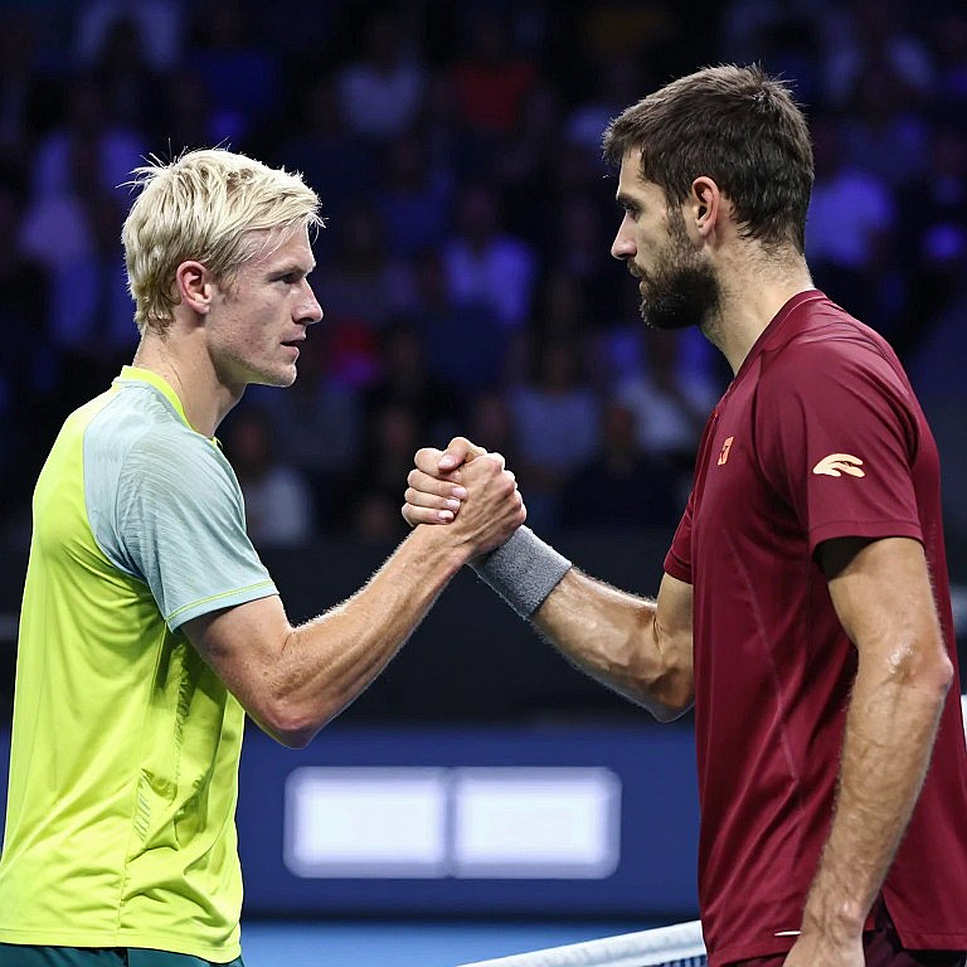
There is one thing I always see in Grand Slam finals, singles or doubles: the brief moment after the final point ends, when all four players stand at mid-court and the scoreboard has not yet changed color, is the most honest moment in sport. All tactical calculations have stopped. All pre-match statements have lost value. Only the bare truth remains that one pair found a way past the other, and they will have to live with that truth until the next match. Siniakova and Townsend lived with it for 1 hour 53 minutes, and they emerged with a title. But the story of the gap between professional specialization and youthful potential remains open, and will likely be retold many times in the seasons ahead.
Bài đề xuất
Alcaraz overcomes first-set shock to advance to second round at US Open 20262026-09-04
Michelsen reads Nakashima's serve, wins tactical masterclass at US Open2026-09-04
Siniakova and Townsend Complete Career Grand Slam: How the Art of Reversal Redefines the Standard of Women's Doubles2026-09-12
Sabalenka's Comeback: US Open Fourth Round Victory2026-09-07
The Points-Defense Window: Return Points Won Writes the Comeback Script2026-09-11
Bài đề xuất
Carlos Alcaraz Returns to US Open 2026: Dramatic Victory Over Faria and Schedule Critique2026-09-04
Zverev and the 2 AM Survival Saga: The Top Seed Digging His Own Grave2026-09-04
Analysis of the Mislabeled Pakistan Sovereign Debt Article as Tennis2026-09-05
Cannot create article: Stage-1 source data is empty2026-09-07
Courts Change Owners, But the Nights of Losing Your Voice Calling Names Are Never Sold2026-09-04
Bài đề xuất
Shelton overcomes Hurkacz: New evidence of American tennis' 'third-round ceiling'2026-09-04
Tennis Analysis Reveals Insufficient Input Data2026-09-06
Sabalenka's Comeback: US Open Fourth Round Victory2026-09-07
Courts Change Owners, But the Nights of Losing Your Voice Calling Names Are Never Sold2026-09-04
Sabalenka vs Rybakina at US Open 2026 Final: Power Clash and Ranking Destiny2026-09-13