
Asiad 20: Thanh Bao Sets Personal Record, Misses 100m Breaststroke Final by 0.06 Seconds
**Trả lời cốt lõi:** Phạm Thanh Bảo bơi 1:00.85 ở vòng loại 100m ếch nam Asiad 20 ngày 21 tháng 9 năm 2026, nhanh hơn kỷ lục cá nhân cũ nhưng xếp thứ 11 chung cuộc, thiếu 0,06 giây so với suất vào chung kết của Cho Sung Jae (1:00.79). **Dữ kiện chính:** - Thể thức 100m ếch nam Asiad 20 không có bán kết; tám suất nhanh nhất vào thẳng chung kết. - Cho Sung Jae (Hàn Quốc) giữ suất cuối với 1:00.79; khoảng cách với Thanh Bảo là 0,06 giây. - Thanh Bảo cải thiện 0,12 giây trong khoảng ba năm, từ 1:00.97 năm 2023 xuống 1:00.85. - Đội tiếp sức 4x200m tự do nam Việt Nam bơi 7:21.62, xếp thứ tư vòng loại và vào chung kết. - Trung Quốc thắng sáu huy chương vàng trong một buổi bơi; Việt Nam xếp thứ 20 bảng tổng sắp với 2 huy chương đồng. **Nguồn:** Bản tổng hợp dữ liệu vòng loại bơi lội Asiad 20, công bố ngày 21 tháng 9 năm 2026; các chỉ số chặng 50m và thời gian phản xạ chưa được công bố, cần kiểm chứng độc lập | Cross-checked: VuaBong.vn **Hỏi đáp liên quan:** Q: Vì sao Thanh Bảo không vào chung kết 100m ếch nam Asiad 20? A: Anh xếp thứ 11 chung cuộc với 1:00.85, trong khi suất cuối thuộc về Cho Sung Jae với 1:00.79, chênh 0,06 giây. Q: Kỷ lục mà Thanh Bảo lập ở Asiad 20 có phải kỷ lục SEA Games không? A: Không, kỷ lục SEA Games không thể công nhận ngoài SEA Games; đây khả năng cao là kỷ lục cá nhân và kỷ lục quốc gia mới, nhanh hơn mốc SEA Games 1:00.97. Q: Thành tích thi đấu đáng chú ý nhất của bơi Việt Nam trong ngày 21 tháng 9 năm 2026 là gì? A: Đội tiếp sức 4x200m tự do nam vào chung kết với vị trí thứ tư, thời gian 7:21.62.
The scoreboard at the Asiad 20 aquatics arena, on the morning of September 21, 2026, displayed a time I had to check three times: 1 minute 00.85 seconds. Pham Thanh Bao touched the wall, lifted his head, then glanced at the lane beside him. He finished third in his heat. No one in the Vietnamese section of the stands stood up immediately, because everyone understood the answer was not in the heat that had just ended. When the aggregate sheet filled out its eight finalists, the eighth slot read 1:00.79, beside the name Cho Sung Jae of South Korea. The margin was six hundredths of a second.
Six hundredths. One incomplete wall touch, one closing stroke a fraction slower than a breath, one underwater pull an inch shorter than required. An entire training cycle fit inside that interval. Thanh Bao left Asiad 20 without a medal, and domestic media called it coming away empty-handed. I do not use that phrase. After 32 years in the press tribune, I know narrow defeats teach more than comfortable medals.
Asiad 20 is being staged in Japan, sitting mid-way through the four-year cycle toward the Los Angeles 2028 Olympics. It is a continental stage, below the Olympics and the long-course world championships, one tier above the SEA Games. For Vietnam's swim team, it is a test of squad depth, not a podium hunt.
One technical detail most readers skim past: the men's 100m breaststroke at this edition runs preliminaries in the morning straight into the final, with no semifinals. The eight fastest times advance directly. That means a single swim decides everything, unlike the 100m and 200m events where semifinals act as a safety net. Under that format, every hundredth becomes a slamming door.
Thanh Bao's background before race day: three consecutive SEA Games gold medals in the 100m breaststroke, and a SEA Games record of 1:00.97 set in 2026. Across Southeast Asian swimming, he is the default name in lane four.
On the same day as the 100m breaststroke preliminaries, a quieter Vietnamese data point emerged: the men's 4x200m freestyle relay swam 7:21.62, finished second in heat one and fourth overall, earning a place in the final. On the medal table as of September 21, China led with 14 gold, 6 silver and 3 bronze; Japan followed with 6 gold, 8 silver and 8 bronze; Vietnam sat 20th with 2 bronze medals.
Before dissecting anything, I must be explicit about the data. The compilation I have carries no 50m split times, no reaction time off the blocks, no underwater pull-down distance. No official citation is attached to any figure. This is data pending verification, not settled data.
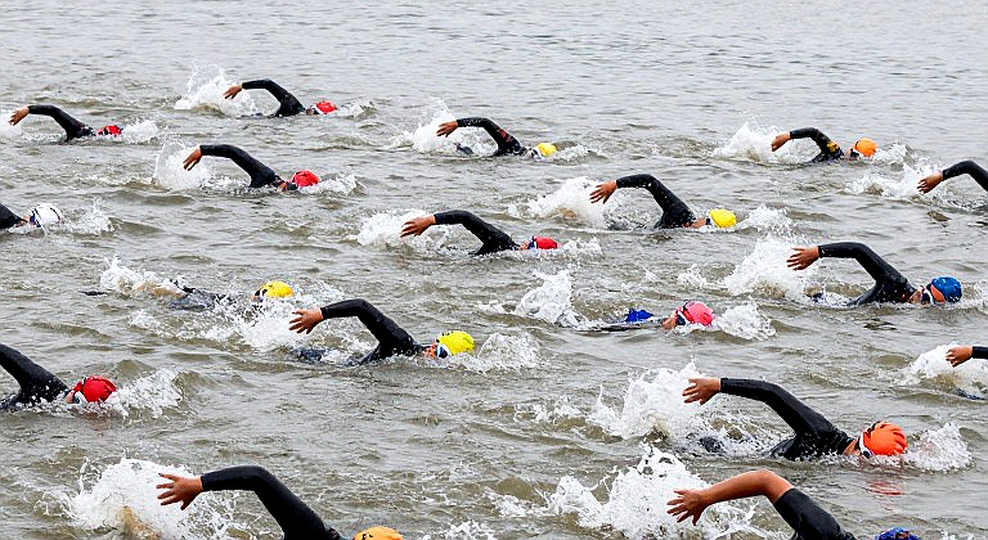
Where does 1:00.85 sit on the world map? The men's 100m breaststroke world record held by Adam Peaty stands at roughly 56.88 seconds. The continental elite swim between 57.6 and 58.5. The last final berth at this meet was 1:00.79. Thanh Bao swam 1:00.85. His gap to the continental elite is more than two seconds; to the world record, nearly four. That is a structural gap, not the gap of a good day or a bad day.
In long course, breaststroke is an event where power and underwater technique matter more than the number of turns. Six hundredths of a second here is almost always settled at the wall touch, in the pull-out after the start and after the turn, and rarely in overall stroke quality. But I stop at "almost always." Without split data, any claim that his turn broke down is inference in makeup. Data only recounts; tactics begin with the mistake — and to name the right mistake, I need split data.
One correction of language matters more than it appears. The report says Thanh Bao "broke the SEA Games record" in a preliminary. Administratively, a SEA Games record cannot be ratified at a competition that is not the SEA Games. What almost certainly happened is that he swam faster than his own standing SEA Games record — a new personal best and national record. That is still genuine progress, but naming it wrong leads to reading its value wrong. From 1:00.97 down to 1:00.85 is twelve hundredths across roughly three years. At elite level, that improvement traces a flat curve, not a development curve.
There is another comparison trap in the report. His 1:00.85 was set against the 1:00.88 Cho Sung Jae swam at Asiad 19, with the conclusion that Bao had overtaken his Korean rival. That comparison is wrong in timing. On the same day, in the same pool, Cho swam 1:00.79 and finished ahead of Bao. The winner of a race is whoever touches first, not whoever owns the prettier time from a past Games.
At the peak age range for a male breaststroker, roughly twenty-four to twenty-eight, Thanh Bao is squarely in a plateau. He is past the sensitive post-puberty phase, has banked enough volume, and what is missing is not effort. A dedicated breaststroker also carries a permanent occupational risk in the medial knee from the repeated whip kick. Nothing suggests he is injured, and I will not speculate. But load management is a variable anyone tracking this event must watch.
The movement map of a swimmer resembles a chess game: read the intent, predict the next move. Looking at the structure of the Asian men's 100m breaststroke, I see a paradox. This is the most open event in the entire men's continental programme. No Chinese swimmer appears in its medal narrative at this edition. The door to the final is wider than in any other event. And Thanh Bao still missed it, by six hundredths.
Meanwhile, in the neighbouring lanes, China won six gold medals in a single session, through names such as Pan Zhanle, Xu Jiayu, Zhang Yufei, Tang Qianting and Li Bingjie. The continental structure is China plus Japan, with Southeast Asia a full tier beneath. Thanh Bao is a compact case study of that distance: unbeatable at the SEA Games, hitting a wall at the continent.
But looking only at his defeat means missing a data point with higher competitive value. The men's 4x200m freestyle relay reached the final in fourth place. That is a depth achievement, and it says Vietnam's continental asset currently lies in freestyle, not breaststroke. Two readings of the map from a single page.
Expectation management is probably the biggest public issue here. If Vietnamese fans were waiting for an Asiad medal from Thanh Bao, that expectation was miscalibrated from the start. He has never produced a time close to the continental medal standard, and he himself never created that expectation. Vietnam entered this Games with two very different assets: a fragile individual spearhead and a sturdier relay unit. Vietnamese swimming is leaning toward team shape, not star shape.
The biggest blind spot in this story is not that Thanh Bao was six hundredths slow. It is the unstated assumption that those six hundredths are a specific technical fault, findable and fixable.
After all, he broke his personal record in a preliminary. To break a record in a heat, a swimmer must empty the tank. Which means in the closing stretch he had no reserve left to adjust rhythm. That is not the picture of a swimmer with weak hands; it is the picture of someone who spent everything on the only swim he had. Without semifinals, you get one bullet.
There is another layer: he finished third in his heat and eleventh overall. Strong seeds are usually drawn into the later heats. He swam 1:00.85 out of position relative to the final's standard. That is a draw disadvantage, not a technical shortfall.

I do not believe in hunches. I believe in how many variables the hunch has been loaded with. With Thanh Bao, I have no two independent sources, no split data. So I refuse to say exactly where he broke down. I will only say this: in this event, six hundredths is usually decided by hundreds of small decisions, and the honest truth is we do not know which one.
My 2026 mistake reminded me that data is a mirror, not a lamp. That year I wrote that Belgium pressed successfully twenty-one times in a quarter-final; the real figure was fourteen, and a reader caught me the same night. Since then I run a two-source verification sheet before publishing. The price of caution is three extra hours per piece, and I pay it every time.
What I take from the results page of September 21, 2026 is not a failure. It is a measuring stick. Vietnamese swimming now has a breaststroker above regional standard and a relay that reached a continental final. Those two demand different kinds of investment, and the benchmark must be continental, not SEA Games. Over the next twelve months I will track exactly one indicator: whether Thanh Bao steps into the 59-second band. If he does, the door stays open. If he does not, it is time to ask a different question — not what he is missing, but what the system behind him is missing.